

Retention Marketing for DTC Fitness Brands: Repurchase Windows and Flow Timing
 Shrestha Ghosal

Fitness is one of the more complicated verticals to build retention around. Unlike supplements or skincare, where the repurchase window is predictable and product-driven, fitness brands often sell across a range of SKUs with completely different buying cycles: a resistance band sells every 8 months, training socks sell every 6 weeks, and a foam roller might never be replaced. Most brands treat all of these the same way, and that is where the revenue leak starts.
This post is for founders and operators at DTC fitness brands doing $1M to $15M. If you are running Klaviyo and your email revenue sits below 20% of total revenue, or your post-purchase flow is doing less work than your welcome series, read on.
Why fitness retention is harder than other verticals
Fitness apparel sits at around a 20-25% repeat purchase rate, according to Bluecore benchmarks. That puts it in the mid-tier for DTC, behind consumables like supplements (which hit 40%+ in top quartile accounts) but ahead of furniture and durable goods. The challenge is that this average masks a lot of variation by SKU type.
A customer who buys a $90 hoodie behaves differently from one who buys a $20 resistance band set. The hoodie buyer is evaluating quality, fit, and whether the brand's aesthetic still resonates. The band buyer probably ran out, broke one, or wants a heavier resistance level. Those are two completely different retention problems, and a single post-purchase flow cannot solve both.
The brands that pull above 30% repeat rates in fitness tend to share one trait: they map their flows to product type, not just to order number.
Finding your actual repurchase window
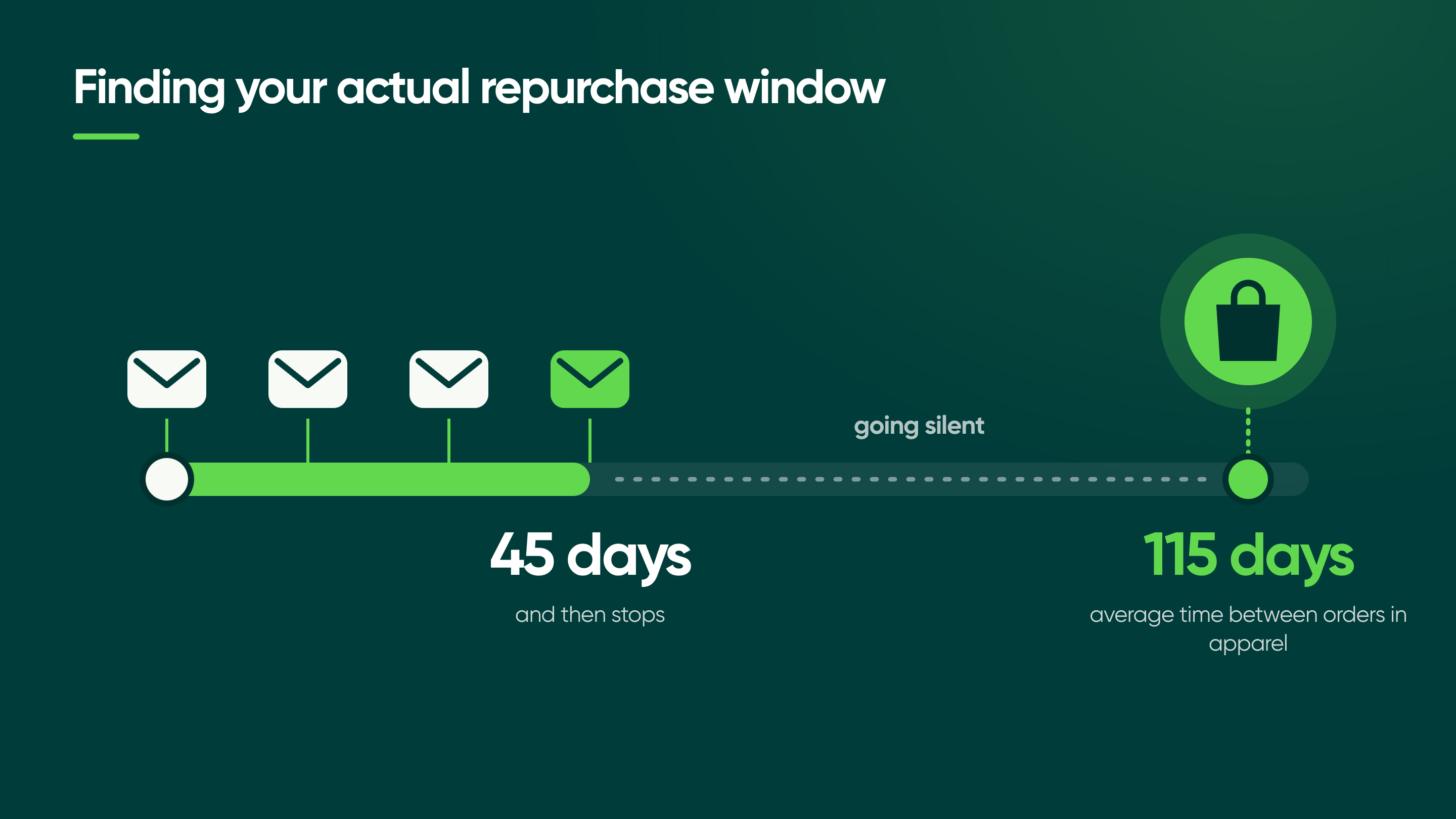
Before you change a single flow, you need to know when your customers actually come back. Most brands guess. Some use a flat 60-day window because they read it somewhere. Neither approach works.
According to data from Metrilo, the average time between orders in apparel sits at around 115 days. That is almost four months. If your post-purchase flow runs for 45 days and then stops, you are going silent at exactly the moment a portion of your customers are deciding whether to buy again.
Here is how to find your actual window in Klaviyo:
- Pull your "Placed Order" event data, filtered to repeat purchasers only.
- Group by the number of days between order 1 and order 2.
- Find where the bulk of second purchases cluster. For most fitness brands, this sits between 45 and 90 days.
- Build a separate view for your top-selling SKU categories: consumables (protein, pre-workout), accessories (bands, socks), and apparel (tights, hoodies).
The result will almost certainly show you three different windows. Your flow architecture should reflect that.
Customers who place a second order within 60 days of their first purchase are three times more likely to become long-term customers than those who wait 120 days or more, according to ecommerce retention benchmarks from Finsi. Getting the second purchase fast is not just about revenue today; it changes the entire LTV trajectory.
The three flow types every fitness brand needs
Consumable replenishment flow
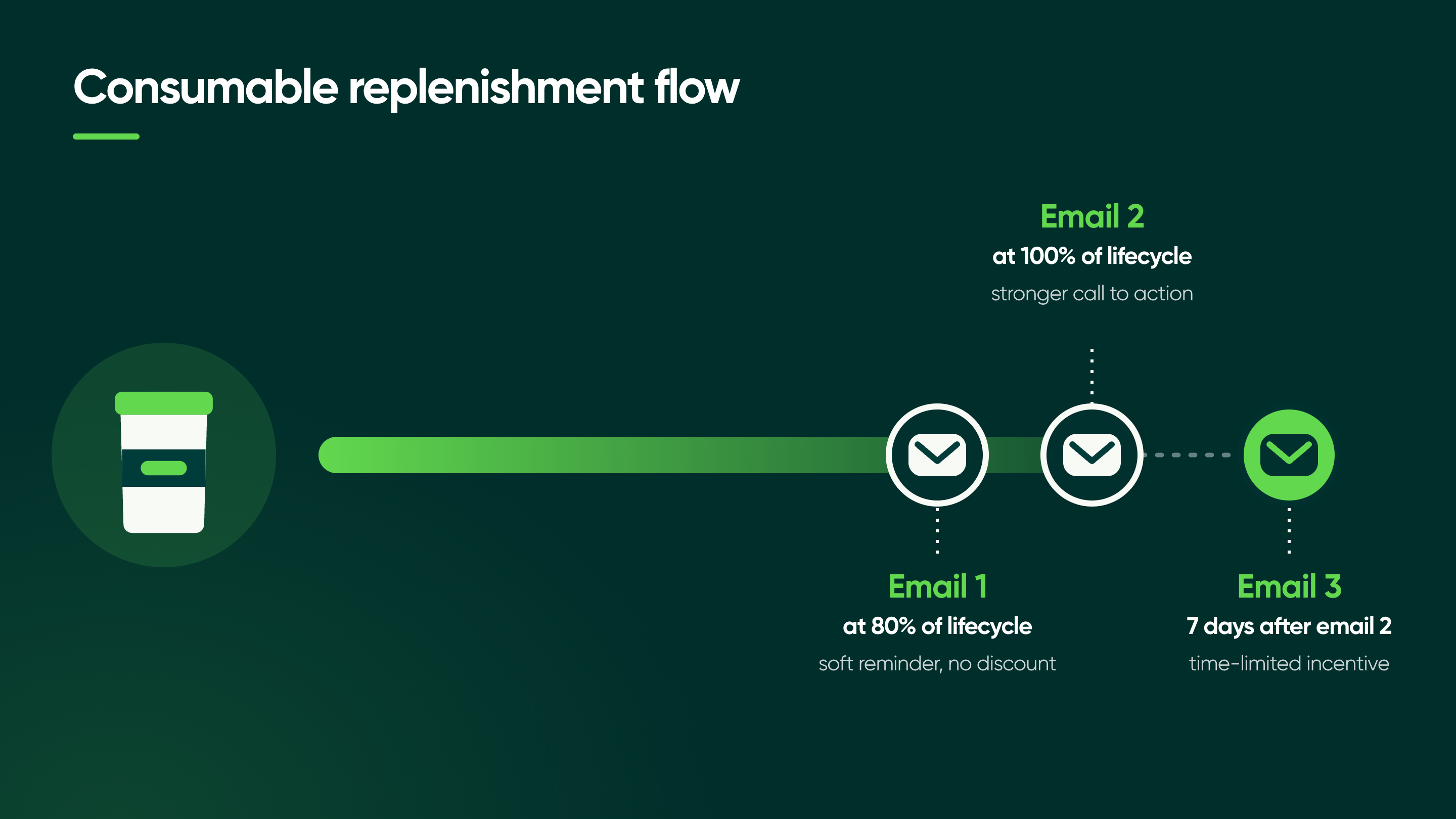
If any part of your product range gets used up, it needs its own replenishment flow. This applies to protein powder, pre-workout, recovery supplements, resistance bands at the lower end of the price range, and training consumables like chalk or grip tape.
The timing logic is simple: find the average product lifecycle from your order data, then trigger the flow at around 80% of that window. If the average protein buyer runs out in 30 days, email them at day 24. Klaviyo's replenishment flow trigger lets you set this at the product level, so a 30-day product and a 60-day product can each have the right timing without building separate flows from scratch.
What the emails should do:
- Email 1 (at 80% of lifecycle): soft reminder, no discount. "You might be running low" framing works well here.
- Email 2 (at 100% of lifecycle): stronger call to action, possibly a bundle offer or loyalty incentive.
- Email 3 (7 days after email 2, no purchase): this is your last shot before they find an alternative. A time-limited incentive is appropriate here.
Post-purchase education flow for equipment and apparel
For higher-ticket items, the retention play is not about replenishment. A customer who just bought a $200 kettlebell set does not need to buy another one in 30 days. What they need is enough value from the first purchase to justify buying the next thing from you.
This is where most fitness brands underinvest. The post-purchase window, from the moment of delivery to around day 21, has open rates that routinely hit 60-70%, according to data from BS&Co's client audits. That is double what a standard campaign gets. Most brands use this window to send one thank-you email and then go quiet.
A better structure for equipment and apparel buyers:
- Day 1 post-delivery: Welcome to the community. Practical content: how to get the most from the product, size/care guide, setup tips. No selling.
- Day 7: Social proof from existing customers. User-generated content, transformation content, workout routines featuring the product.
- Day 14: Cross-category introduction. If they bought equipment, introduce apparel. If they bought apparel, introduce a consumable add-on. Make the recommendation feel earned, not random.
- Day 21: Review request. You have given them time to actually use the product; now ask what they think.
- Day 45-60: Repurchase nudge based on product category, or introduce a subscription option if available.
Winback flow for lapsed fitness customers
A winback flow in fitness needs to account for something most templates ignore: seasonal behavior. Gym attendance spikes in January and September. New year, back-to-school, post-summer reset. Customers who went quiet in May may not be churning; they may just be in a different phase of their fitness routine.
Most brands trigger winback at 90 days of inactivity. For fitness brands, that can be too aggressive. A customer who bought cycling kit in March and does not repurchase until October is a seasonal buyer, not a churned one. Segment by first purchase category before setting your winback timing.
For non-seasonal lapsed customers (no purchase in 90-120 days, no engagement in 60 days), a three-email winback works:
- "We noticed you've been quiet" acknowledgment. No discount. Just a low-pressure re-entry point, often a piece of useful content or a new product they have not seen.
- A specific product recommendation based on their original purchase, with a modest offer.
- Final email: last chance framing. Clear, direct, no hedging. Either they come back, or you move them to a suppression segment.
The brands that recover the most lapsed customers do not lead with discounts. They lead with relevance. A customer who bought beginner yoga gear in January does not want a 20% off code in September. They want you to acknowledge where they are in their fitness journey and offer something that matches it.
SMS and email: how to sequence them
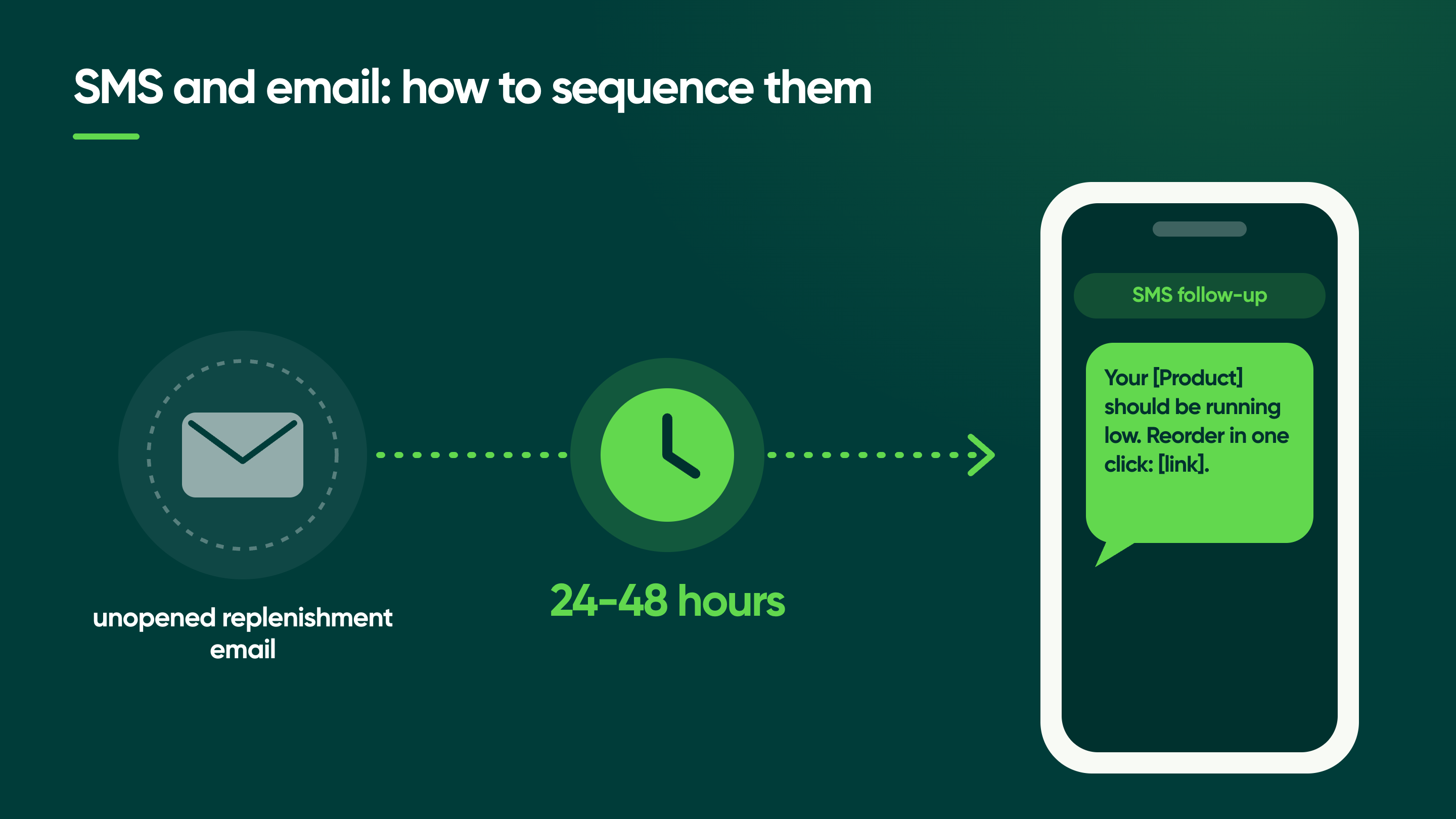
For fitness brands, SMS tends to outperform email on time-sensitive replenishment reminders. The read rate is higher and the action is faster. But the sequencing matters.
A common mistake is sending the same message on both channels within 24 hours of each other. That is not multi-channel; it is just repetition with a different UI. A better structure:
- Email first for content-heavy messages: education, reviews, product stories.
- SMS for replenishment nudges where speed matters. Customers who have run out of product are making a decision now, not in 48 hours.
- SMS as a follow-up to unopened emails in the replenishment sequence. According to Titan Marketing Agency, an SMS follow-up sent 24-48 hours after an unopened replenishment email can lift conversions in that sequence meaningfully.
Keep SMS short. A fitness-specific replenishment SMS reads something like: "Your [Product] should be running low. Reorder in one click: [link]." That is it. No emojis, no three-sentence build-up.
The segmentation layer most fitness brands skip
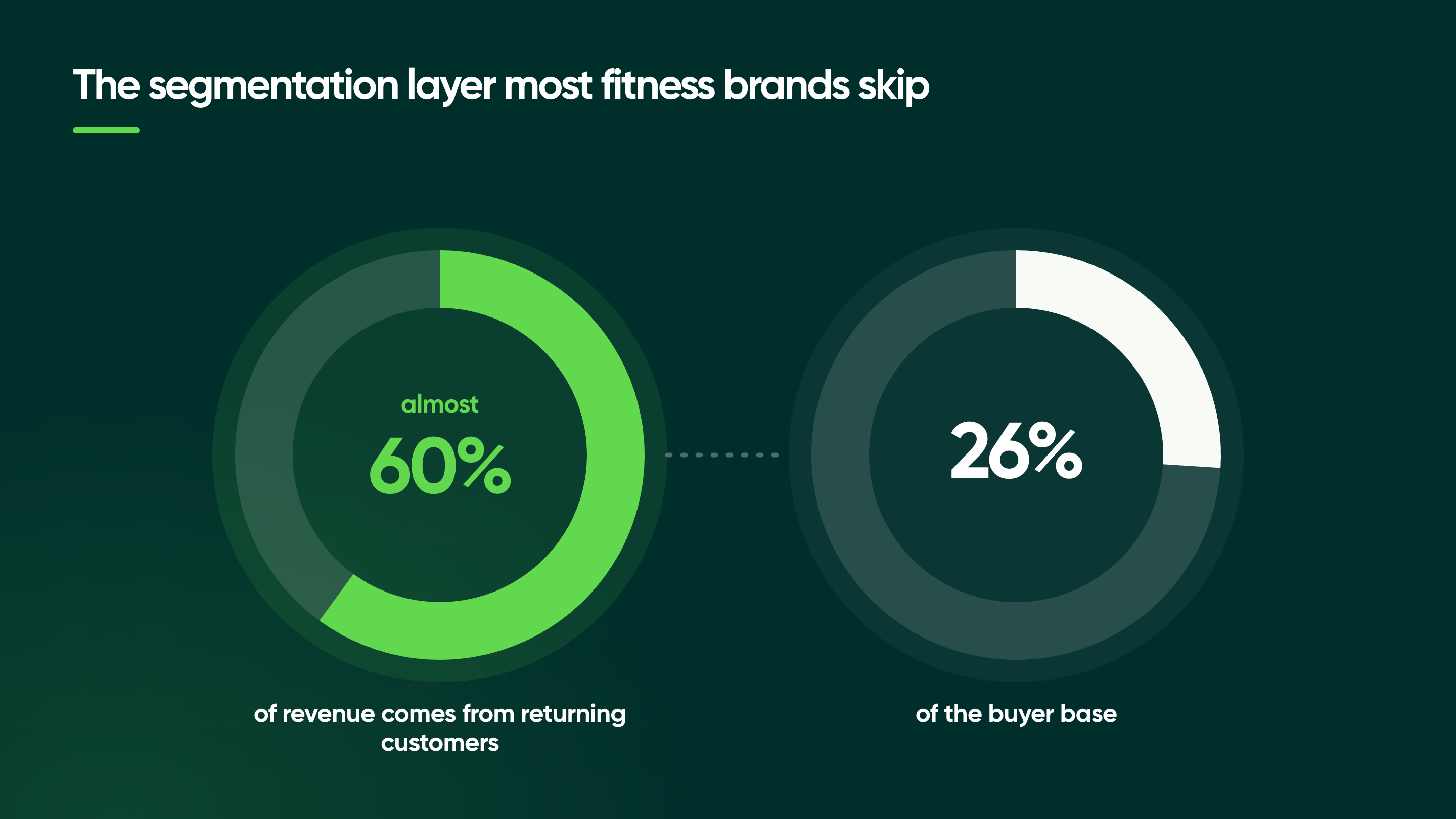
Everything above assumes you are talking to a single customer type. In reality, your list has at least three distinct groups that need different treatment:
Consumable buyers. Highest repurchase potential. Place them in a dedicated replenishment flow, exclude them from general campaigns during their active flow window, and target them with bundle and subscription offers over time.
Equipment buyers. Lower repurchase frequency but high cross-sell potential. The goal is to move them from single-product buyers into category buyers. Email content should introduce adjacent products progressively, not all at once.
Apparel buyers. Seasonal and style-driven. These customers respond to new drops, limited editions, and community-driven content. According to Metrilo's DTC report, in well-run fitness apparel brands, almost 60% of revenue comes from returning customers, even though they make up 26% of the buyer base. The LTV is there; it just requires consistent community-building content, not just transactional reminders.
Run an RFM (Recency, Frequency, Monetary) analysis on your Klaviyo account before building any new flows. Group customers into these three product cohorts first. A single retention strategy applied to all three will underperform each segment individually.
What good looks like at $1M vs $5M
At $1M, you probably do not need all of this in place at once. Start with two flows: post-purchase (7-email sequence, split by first-time and repeat buyer) and a replenishment flow for your highest-volume consumable SKU. Those two alone will move your email revenue share.
At $5M, the above is table stakes. The differentiation comes from SKU-level replenishment timing, seasonal winback segmentation, and a cross-sell architecture that moves consumable buyers into apparel and vice versa. At this stage, you should also be looking at Klaviyo's predictive analytics to identify customers approaching their expected repurchase date and triggering flows before they search for an alternative.
Where to start
Pull your repurchase window data this week. It takes less than an hour in Klaviyo or your analytics tool. Segment it by product category. The number you find will tell you whether your current flow timing matches your actual customer behavior.
Most fitness brands running a standard 30-45 day post-purchase flow are going quiet 30 to 60 days before a significant portion of their customers are ready to buy again. That gap is not a data problem; it is a flow architecture problem, and it is fixable.
If you want a second set of eyes on your Klaviyo setup, we will pull your data, map your current sequences against the benchmarks in this post, and tell you exactly which flows to build first. Book a call with us.
Keep reading.
All posts
8 Email Flows Built Specifically for Food and Beverage Brands on Shopify
Shrestha Ghosal · Jun 15, 2026

6 Segmentation Strategies That Work Specifically for Fashion E-commerce Buyers
Shrestha Ghosal · Jun 15, 2026

The Trust Gap in Wellness Retention: Why Your Customers Ghost After the First Purchase
Shrestha Ghosal · Jun 12, 2026